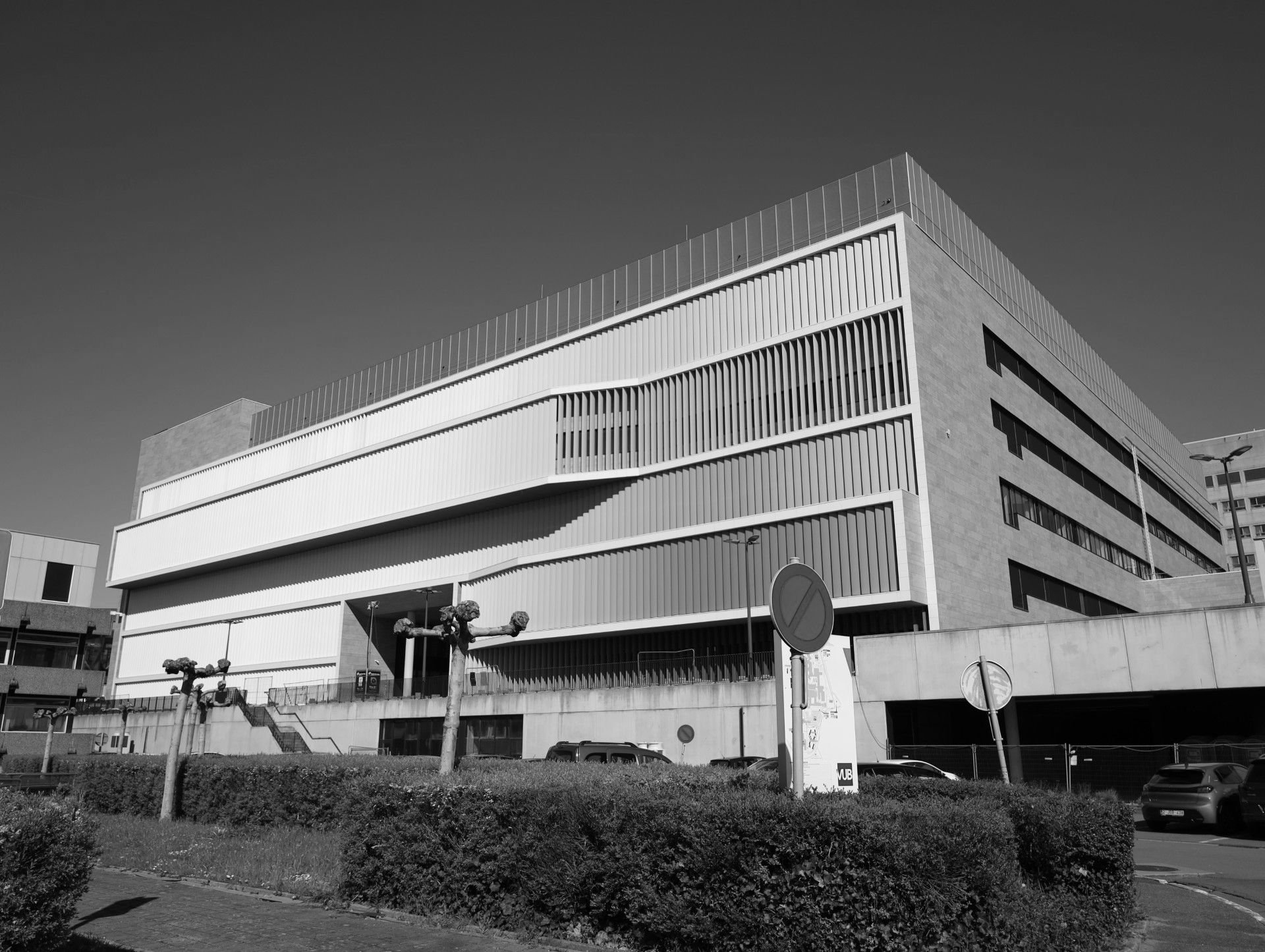
Modern hospitals rely heavily on large, glazed façades to maximise natural light and support patient wellbeing. Daylight has long been recognised as a contributor to recovery, helping to regulate circadian rhythms and improve psychological comfort. However, this design priority brings unintended consequences. Without effective solar control, extensive glazing can create overheating, glare and unstable indoor conditions – factors that directly affect both patient outcomes and staff performance.
This challenge is particularly evident at UZ Brussel, one of Belgium’s largest academic hospitals. The hospital employs around 5,000 staff, support more than 30,000 admissions and over 360,000 consultations each year across a 721-bed facility.
Operating at scale and across a wide range of specialist services, the hospital is undergoing a long-term redevelopment programme to modernise its estate while maintaining day-to-day clinical operations.
Within this context, the modernisation of the hospital’s Technical Medical Block brought a specific set of challenges into focus. Working with engineering consultancy Sweco, installation and integration partner Equans, and Somfy as technology provider, UZ Brussel set out to improve patient comfort, reduce overheating and glare, and optimise building performance – without disrupting critical clinical environments.
In critical environments where comfort, visibility and consistency are essential, these issues are more than just operational inconveniences. They are clinical risks. At UZ Brussel, addressing these challenges within a live hospital environment has required a more intelligent and responsive approach to managing daylight and solar gains – one that moves beyond static solutions and towards dynamic control.
The challenge: balancing daylight, comfort and energy
Hospitals represent one of the most demanding building types when it comes to environmental performance. Spaces must deliver consistent lighting conditions, stable temperatures and a high level of visual comfort, often across multiple façade orientations and functions.
At UZ Brussel, these challenges were particularly acute. Several façade zones with high daylight exposure and significant internal heat loads were contributing to glare on medical equipment and screens, as well as periods of overheating. At the same time, the hospital needed to maintain strong connections to natural daylight, creating a delicate balance between openness and control.
Overlaying this was the operational complexity of a hospital setting. Any solution had to be reliable, quiet in operation and capable of supporting clinical workflows without disruption.
Why static solar control is no longer sufficient
Traditionally, solar control in healthcare buildings has relied on static interventions such as fixed louvres, solar coatings or internal blinds. While effective in certain conditions, these approaches are inherently limited in their ability to respond to changing environmental factors.
Sunlight is not static. It shifts throughout the day and across seasons, varying in intensity and angle. Static systems cannot adapt to these fluctuations, often resulting in environments that are either overexposed or overly shaded.
This lack of control leads to compromise. Internal blinds are frequently used to manage glare, but are often left partially or fully closed, reducing daylight access and creating inconsistent conditions across spaces. At the same time, buildings may rely more heavily on mechanical cooling systems to counteract solar heat gains.
The case for dynamic, responsive façades
In environments such as UZ Brussel, the challenge is not simply to reduce solar gain, but to manage competing requirements in real time – balancing daylight, glare control, thermal stability and operational continuity across different façade zones.
In this context, a more responsive approach to solar control becomes necessary. Rather than relying on fixed or manually adjusted systems, UZ Brussel identified the need for a solution capable of adapting continuously to changing daylight conditions, while remaining aligned with the hospital’s clinical and operational requirements.
This led to the implementation of a dynamic control system based on KNX – a building automation standard that connects and coordinates different building systems through a single control network. Supplied by Somfy and integrated across external screens and vertical louvre systems, the system responds to factors such as sun position, façade orientation and weather conditions, adjusting shading automatically throughout the day.
By coordinating these façade elements in real time, daylight can be managed more precisely at the building envelope. This helps to limit glare – particularly on medical equipment and screens – while reducing unwanted solar heat gains before they affect internal conditions.
Integrating shading into design and building management
A defining feature of the UZ Brussel project was the early integration of solar shading within both the design process and the wider building systems strategy.
The system is designed to operate as part of a wider building management approach, allowing solar control to function alongside other building services rather than in isolation. This integration supports a more coordinated response to environmental conditions across the building.
Importantly, the solution combines centralised automation with local override where clinically required. This ensures that performance remains consistent while still allowing flexibility in spaces where staff control is necessary – an essential consideration in healthcare environments.
Measurable and observed benefits
Since commissioning, the installation at UZ Brussel has delivered clear and immediate improvements.
Glare on screens and medical equipment has been significantly reduced, addressing a core operational concern in clinical spaces. Indoor temperatures have become more stable during periods of high solar exposure, contributing to improved comfort for patients and staff.
While long-term performance data is still being gathered, early observations indicate a reduction in cooling demand during sunny conditions, supporting both energy efficiency and more stable system operation. In practice, by limiting solar heat gains at the façade, the system helps to reduce reliance on mechanical cooling in certain areas and during peak periods—although, in a hospital environment, active cooling remains essential for maintaining strict environmental conditions in critical spaces.
These benefits demonstrate the value of dynamic solar shading in environments where consistency, comfort and performance are critical.
Lessons for healthcare design teams
The UZ Brussel project reinforces several key principles for healthcare design.
1. Solar shading should be considered from the outset. Early integration enables systems to be aligned with building orientation, usage patterns and technical infrastructure.
2. Collaboration is essential. The partnership between Sweco, Equans and Somfy ensured that the system was not only technically effective, but also robust and suited to the specific demands of a hospital setting.
3. Solutions must be designed with users in mind. Reliability, quiet operation, minimal disruption and compatibility with clinical workflows are all critical to successful implementation.
The future of solar control in healthcare
As climate pressures intensify and healthcare buildings continue to evolve, the need for intelligent, responsive façade solutions will only increase.
The UZ Brussel project demonstrates how dynamic solar shading can move beyond a technical upgrade to become a strategic design tool – supporting patient wellbeing, improving energy performance and enhancing the overall resilience of healthcare environments.
With the involvement of specialist partners and the integration of advanced control systems, hospitals are increasingly able to manage the complex relationship between daylight and heat with precision.
For future healthcare projects, the direction is clear: static solutions are no longer enough. Dynamic solar shading offers a pathway to buildings that are not only more efficient, but also better aligned with the needs of those who use them every day.